Your moat is moot
Pick a job to try this on: the Job Picker ranks your repeated jobs.
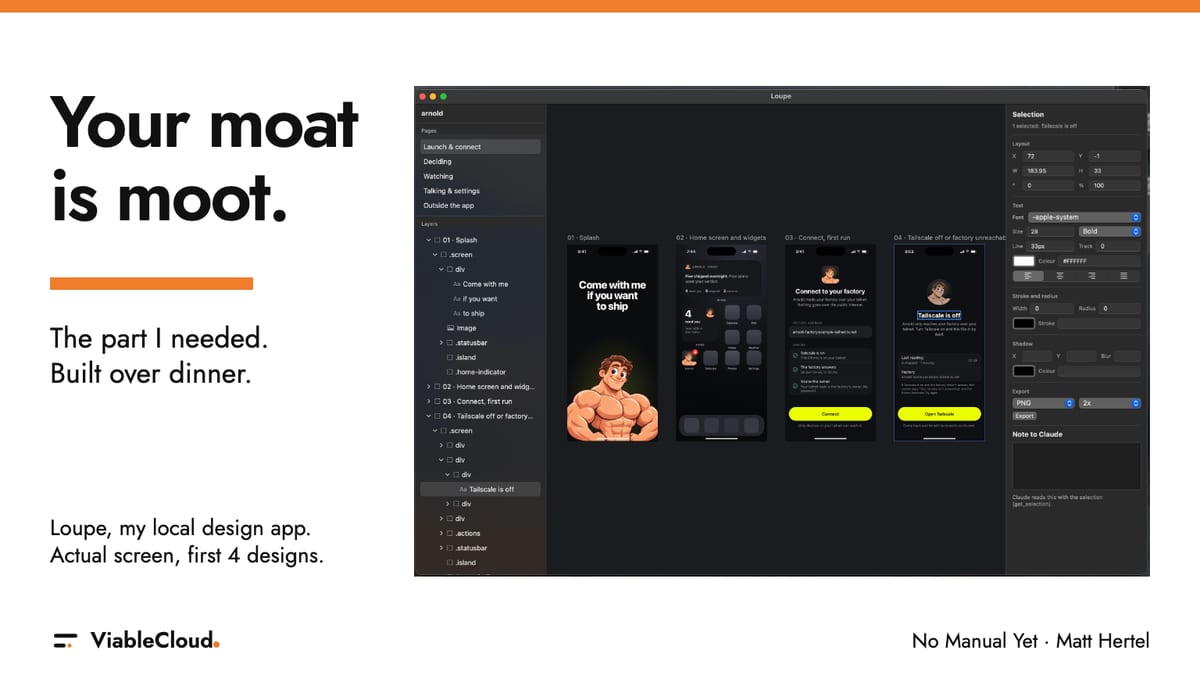
You know when you find a tool that does exactly what you need, then discover the one thing you want sits inside another monthly subscription?
$20. All sorts of lovely features. Most of which you’ll probably never touch.
I got there this week.
There’s a fantastic design tool called Paper. I wanted to use it for the mobile app for my software factory. I already had the designs, and Claude could move them across for me.
Lovely. One small job.
After about 5 minutes, 8 of my 21 screens were there. Then we used up the whole weekly allowance.
The upgrade was $20 a month.
Now, I liked the product. It was doing what I wanted. This should have been a fairly straightforward sale.
Instead, I asked Claude a slightly unreasonable question.
And if you run a business, the answer is worth thinking about before your customers ask it too.
Here's my actual prompt, typos fixed:
How annoying. We ran out of the whole thing. Can we recreate a Paper-like app that is just for me? You know what the MCP shape looks like so shouldn't be hard writing, rendering and build an app about it.
Not exactly a product requirements document.
Claude came back with a bunch of questions. Did I want a web app or a local Mac app? How would I want to make edits?
My reply, also typos fixed:
I very rarely will make edits myself in terms of full canvas. I'm terrible at design. I think should be a local only Mac app + MCP. Spawn a Opus 5.5 xhigh. Give it all the context and write a plan to make that.
(For the non-nerds: that's Opus 5.5 on extra-high effort.)
Then I went to get dinner.
By the time I was back, all 21 screens of my Arnold factory were there.
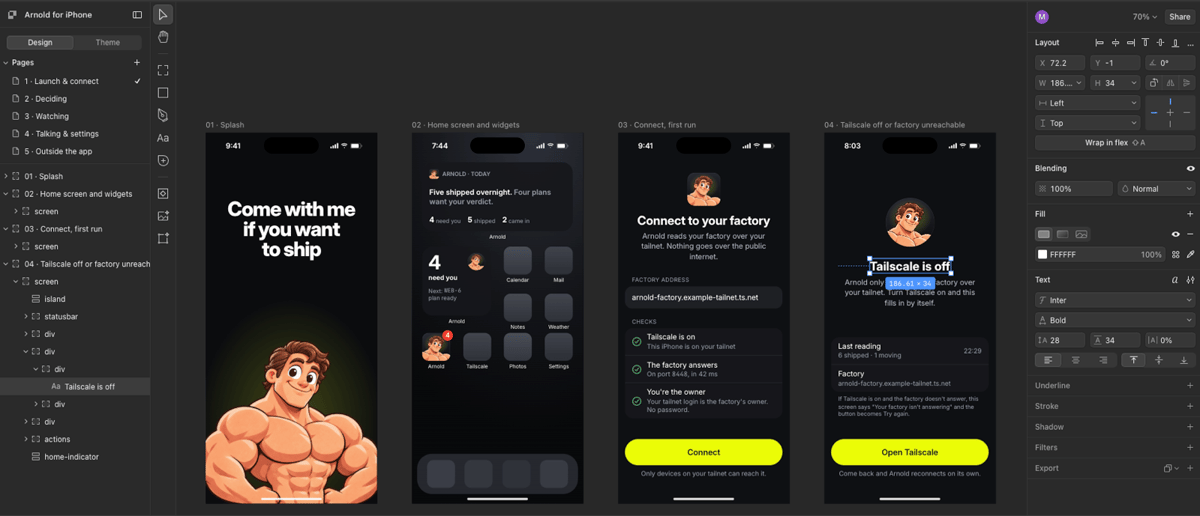
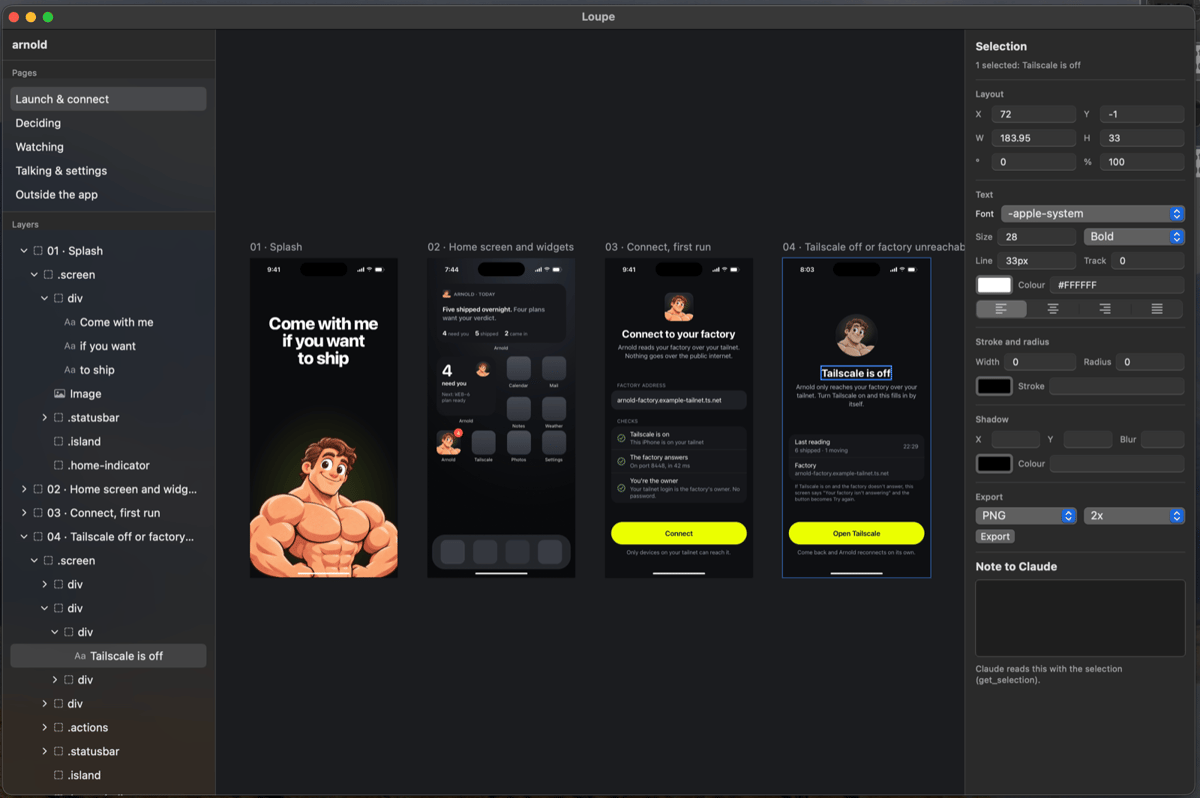
Paper, then Loupe. These screenshots show the first 4 screens.
And I could have an agent iterate over them. Which was the whole point.
It's called Loupe. I have no idea why.
Did I just build the Paper killer?
Will this make a dent in Paper? Absolutely not.
Did I just build the Paper killer? Again, no.
Should Paper be worried? Maybe.
Let's be honest about what I actually did. I replaced the one slice I needed, for me. I didn't rebuild Paper. I didn't build it for a team, and I haven't shown it's anywhere near as reliable. Loupe also isn't free to keep around: when it breaks, that's my problem, and the model doing the work doesn't run on goodwill.
To be fair, my designs were already in an HTML file, and Paper also lets you paste HTML straight onto the canvas. I'd gone the MCP route instead (that's the connection that lets Claude work inside Paper for me), and that's the allowance that ran dry.
Here's the part that should bother anyone selling software.
Nobody launched a competitor. No startup, no price war, no shiny launch video. One person facing a $20 decision had a build option sitting right next to the upgrade button.
A missing sale doesn't need a competitor to launch.
I can't tell you what that's worth to Paper. I can tell you the upgrade button had company.
For years the maths was simple. Building software was slow and expensive, so when a tool did 1 thing you needed and 10 you didn't, you paid for the 10 and got on with your day. That constraint isn't true any more.
Building is the cheapest bit now.
Which is the big point: software is no longer a moat. Any product can be "one Claude away" from being replicated. And by product I mean the slice a customer actually needs. It doesn't mean your whole business, a physical service, a security guarantee or a production system that has to stay up at 3am. Those are a much longer conversation.
But the slice is often the bit people were paying for.
So what does that mean if you're the one selling the $20 plan?
What are your customers actually paying for?
Your wake-up call is checking what your moat really is.
Two questions. Why do customers pay you? And what would still make them choose you once the software is easy to reproduce?
"Because it's hard to build" doesn't count any more. (Sorry.)
There are two very different ways this goes wrong, and it's worth keeping them apart.
Risk one: what you deliver gets replaced.
Take a hypothetical SaaS that pulls in data its customers can already reach (their CRM, their ad accounts, their bank feed) and shows it on a nice dashboard. That company should worry.
The customer already has the access. They look at the product every week, so they know the shape of every screen. That's exactly where I was with Paper: the designs were mine, and Claude already knew the shape of the MCP. A lot of the thinking was done before I asked.
Risk two: you lose the customer before you deliver anything.
Now take a plumber. The core offering is safe, because a leaking pipe still needs a plumber and Claude doesn't own a spanner.
But everything around the work can change: how people find a plumber, how they get a quote, how they book. If the plumber doesn't keep up with that, getting customers might get harder, even though the work itself hasn't changed at all.
Speaking purely for myself: if I have to call your office to book an appointment, you've already lost me. Plenty of people are happy to pick up the phone. I'm just not one of them.
You're not a plumber. (Probably.) But if you sell a service, you're closer to one than you might think. The work may be safe. The enquiry form, the quote that takes days and the booking that needs a phone call can be where customers quietly slip away.
If you sell software, look hard at the dashboard. Then look at your own product and ask how much of it is a dashboard.
So what does keep a customer paying? Data they can't get anywhere else, a product that keeps working without them thinking about it, someone to call when it breaks, other people they need on the same product, and trust. Any of those can be a real moat. Each one only counts once you've got evidence for it. "Customers love our support" is a lovely sentence for a pitch deck. A customer who renewed because of one support call is evidence.
Let's start with why they pay. One customer, their actual words and one thing you can check this week.
Something you can implement by Friday
Pick one customer and write down why you think they still pay you.
One sentence. Then find something they've actually said that supports it. A renewal email, a buying conversation, a reason they chose you over someone else.
Put the two side by side. Your reason. Their words.
If you'd like Claude to help, remove the private details and give it this:
I think this customer pays us because [my reason]. Here's what they actually said: [their words]. What does this support, and what am I assuming? Don't fill the gaps. Give me one question I can ask them to check the biggest assumption.
Read its answer against the original words. Has it found evidence, or has it politely agreed with you? Then ask the customer that question. If you can't find anything they said in the first place, start there.
That's a useful Friday result: one reason for paying, checked with the person doing the paying. You might discover that the feature you're proudest of barely enters the decision. Or that the boring bit you were about to cut is why they renew. Better to find out before you cut it.
But that won't tell you how easily someone could replace the job, or whether you're losing people before they even get to buy.
I've put the full assessment in the free download: the prompt that interviews you and rates both risks, worked dashboard and plumber examples, the evidence that should change a score, and a plan for testing the cheapest credible alternative. There's a printable decision sheet and an editable helper kit too.
Get the full moat check. Bring your own business. I've supplied the awkward questions.
If it changes a decision, tell me. I'd love to see what you found.
No manual yet
The bit your customer needs can be one Claude away. So can the bit you could do better.
A $20 decision now comes with a build option. Mine did, and all 21 screens were there by the time I got back from dinner.
The dinner trick works both ways. Your customers can build around you, and you can build the fast quote, the online booking or the bit people would happily pay more for. Past constraints aren't true for them any more, and they aren't true for you either. And you're the one who knows the job.
I'm still ridiculously excited about what we can build now.
I'd still like to know why it's called Loupe.
You survived another week in this strange new world AND another one of my articles. Amazing!
Over to you now: which bit of what you sell could a customer rebuild over dinner?
Take it with you
Your moat check: the reusable helper
The full assessment prompt, two fictional worked examples, an evidence template, customer questions and an editable decision record.
ZIP · 9 KB
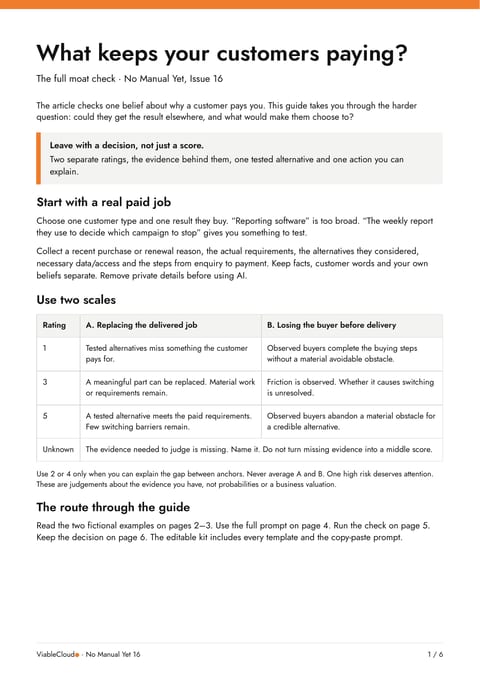
What keeps your customers paying?
A six-page guide with the full assessment prompt, two worked examples, a real-world test plan and a printable decision sheet.
PDF · 96 KB