Claude saved my bacon.
Pick a job to try this on: the Job Picker ranks your repeated jobs.
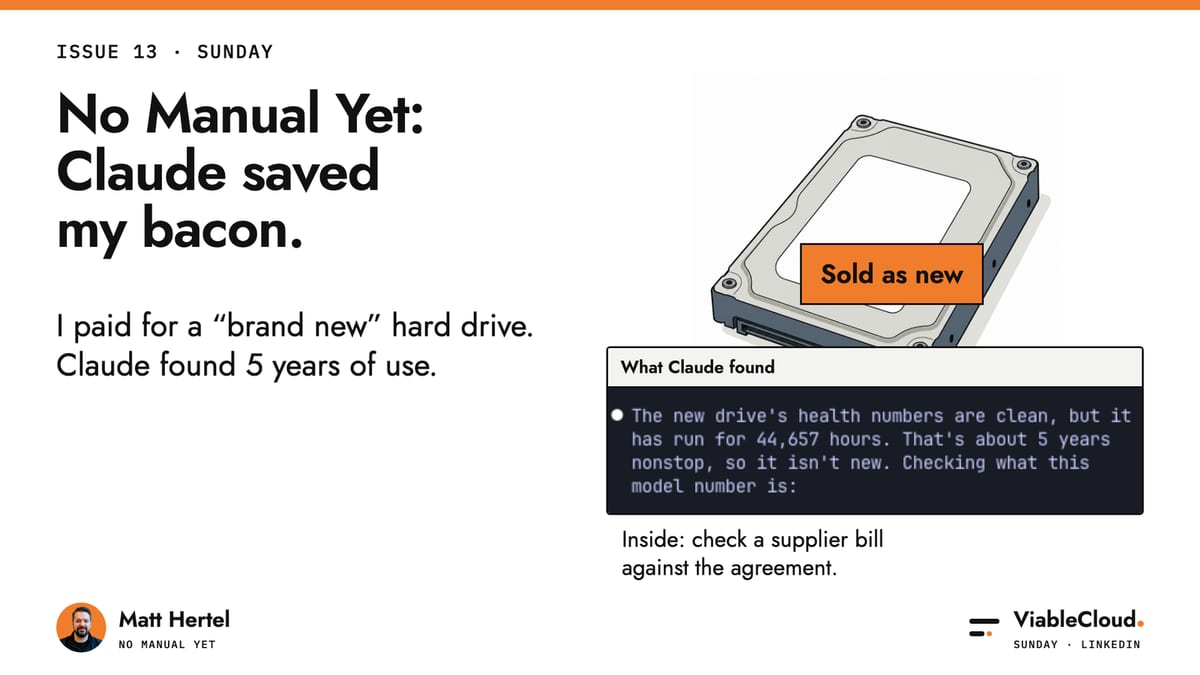
I thought I'd found a bargain.
One of my bots, Deal Sniper, had been watching hard-drive deals for me. It found a “brand new” drive at a price I was very happy with, so I bought it for my NAS, the box that stores my files. Happy days.
Then the postman threw the package over my gate.
I have it on video. Not normally something I need when installing a hard drive, but there we are.
That landing was the reason I plugged it in and asked Claude to help me check whether it had been damaged. The drive's health numbers looked clean. Its history was a different matter:
The new drive's health numbers are clean, but it has run for 44,657 hours.
About 5 years of running time. On a drive I'd bought as new.
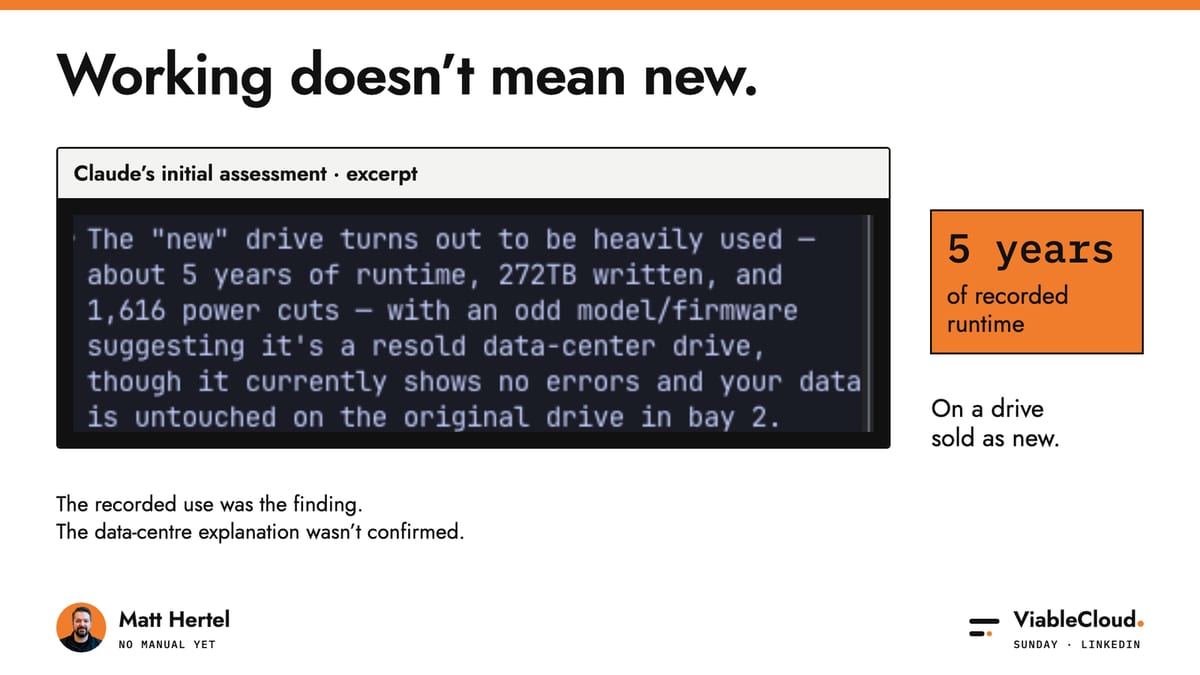
There was a Microsoft reserved partition on it too.
Excuse me?
Claude asked whether I'd bought it new or used. I'd been worried about the trip over the gate. I hadn't thought to question what the seller had sent me.
Before AI, I'd have kept it
I'd have plugged the drive in and got on with my life. I'd bought it new. Why would I be checking whether it was new?
I wouldn't have known I had a problem.
Once Claude spotted it, it helped me gather the evidence, research my rights and work out what to ask the seller for. I've requested a replacement. I'm still waiting.
Maybe it was a mistake. Maybe it wasn't. Either way, I had evidence to put in front of the seller instead of a drive quietly doing its 6th year of work in my house.
We spend a lot of time talking about AI making things faster. This was a job I wouldn't have started.
And I think that's where a lot of the useful stuff is hiding.
We need to look again at the jobs we've written off as too much hassle. We made those decisions when we had to do all the checking, reading and chasing ourselves.
Deal Sniper got me the price. What caught the problem was checking what actually turned up against what I'd been promised. And I was only looking for dents.
Your business has the same gap, except it's every month. You agree a price with a supplier once. Then the bills turn up and get paid without anybody comparing them with that agreement (I promise this isn't turning into a hard-drive newsletter).
Are you paying what you agreed?
Pick a supplier bill that looks roughly the same every month. Broadband, IT support, a software subscription. You recognise the total, the service still works, you pay it.
Checking it properly means finding the agreement, finding the changes and working out whether somebody approved that extra charge. Then there's the email if something doesn't match.
A lovely little hobby for a person who already runs a company.
In Ofgem's 2025 research into businesses' experience of the energy market, billing issues featured in 41% of complaints and overcharging in 27%. That's among businesses that complained about their energy supplier, not all businesses.
Some businesses in the interviews had given up trying to get their complaint resolved. My guess? If chasing a bill feels that painful, most of us never start checking in the first place.
AI can compare the paperwork, check the sums and help you write the query. You still need the documents and somebody still needs to read the result. But finding out whether there's anything to question no longer has to become your evening's entertainment.
Here's a made-up example. Your agreement says 30 software licences at £18 each. The invoice charges for 32. That's £576 against £540, a difference of £36 before VAT.
Maybe somebody added 2 people. Maybe the change starts next month. Maybe the supplier made a mistake.
The question I'd ask: what authorised those extra 2 licences?
Give AI the agreement and the invoice, and make it point to the lines behind its answer. If it can't find the approval, you have a question to ask. You don't yet have proof you've been ripped off.
I already have enough drama with the airborne hard drive.
Something you can implement by Friday
Start with one charge on one invoice. Pick a recurring supplier where you can find the agreement or accepted quote, plus any approved changes.
Use the AI tool your business permits for these documents. Remove bank details and unrelated personal information. Attach the paperwork and ask:
Compare this recurring charge with what we agreed. Check the price, quantity and billing dates against the agreement and approved changes. Show the calculation and the exact file and line behind your answer. If something's missing, name it. Don't assume the supplier is wrong.
Open the lines it cites and check them yourself. You should finish knowing that the charge matches, that it differs, or which document you still need. Any of those three is a win. Even the last one, because now you know exactly what to ask for.
As always, I've made you something to walk you through the rest of the job.
The Supplier Bill Check guide takes you through 3 invoices, approved changes, duplicate charges and credits. It includes the full prompts, a worked example with the answers, a place to record the evidence and a supplier email you can adapt.
The separate Supplier Bill Check kit gives you the editable files: a fictional agreement and invoices to practise on, a blank comparison sheet, the prompts and the follow-up templates. You can try it on the example before giving it your own bills.
The guide finishes with what to keep for next month. Because finding the same agreement all over again would be a slightly silly use of our exciting new technology.
By Friday, aim for one supplier checked, with a clear answer or a specific question to send.
No manual yet
I wouldn't have checked that hard drive before AI. That's the bit I keep coming back to.
I only asked Claude about damage. It told me about 5 years of somebody else's use. Your supplier bill is the same check: what you agreed against what actually turned up.
I reckon a lot of the jobs we wrote off are worth another go now.
Checking one supplier is great. The hard bit is making sure somebody checks next month's bill too, with the current paperwork, a named person who actually reads the answer and a note of what happened. Otherwise it's a nice one-off and next month's bill sails straight through again.
I'm still ridiculously excited about what we can do with this stuff.
I'd just prefer the next delivery to use the gate in the conventional way.
You survived another week in this strange new world AND another one of my articles. Amazing!
Over to you now: which supplier bill would you check first?
Take it with you
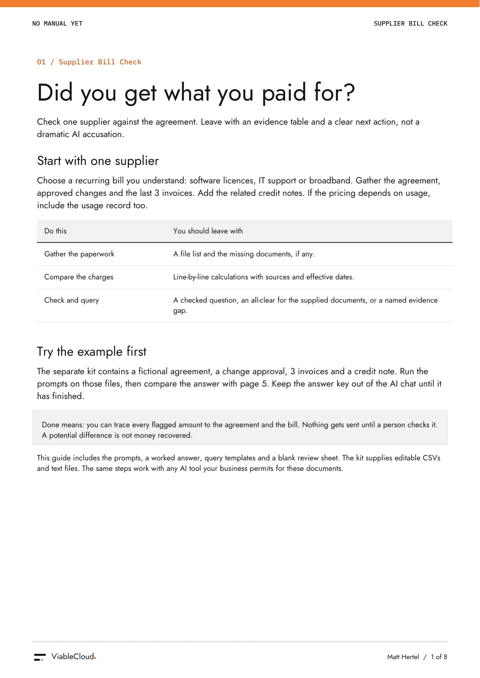
Check a supplier bill against the agreement
An eight-page guide with four prompts, a worked example, an answer key and supplier email templates.
PDF · 46 KB
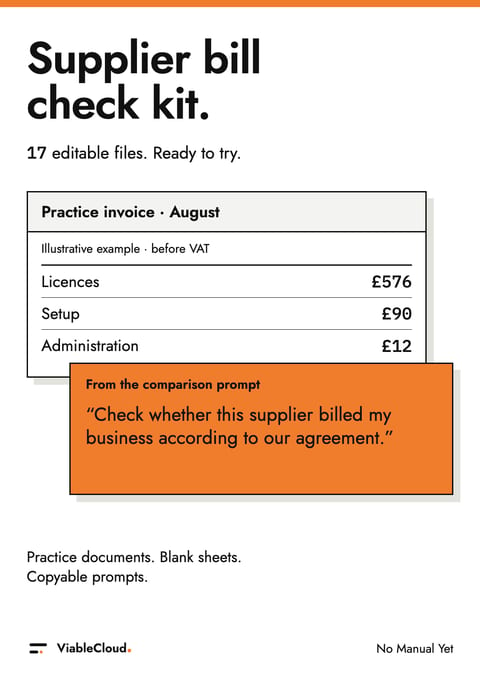
Supplier Bill Check: the practice kit
A ZIP with 17 files: practice documents, four prompts, an answer key, three blank CSV sheets and two email templates.
ZIP · 8 KB