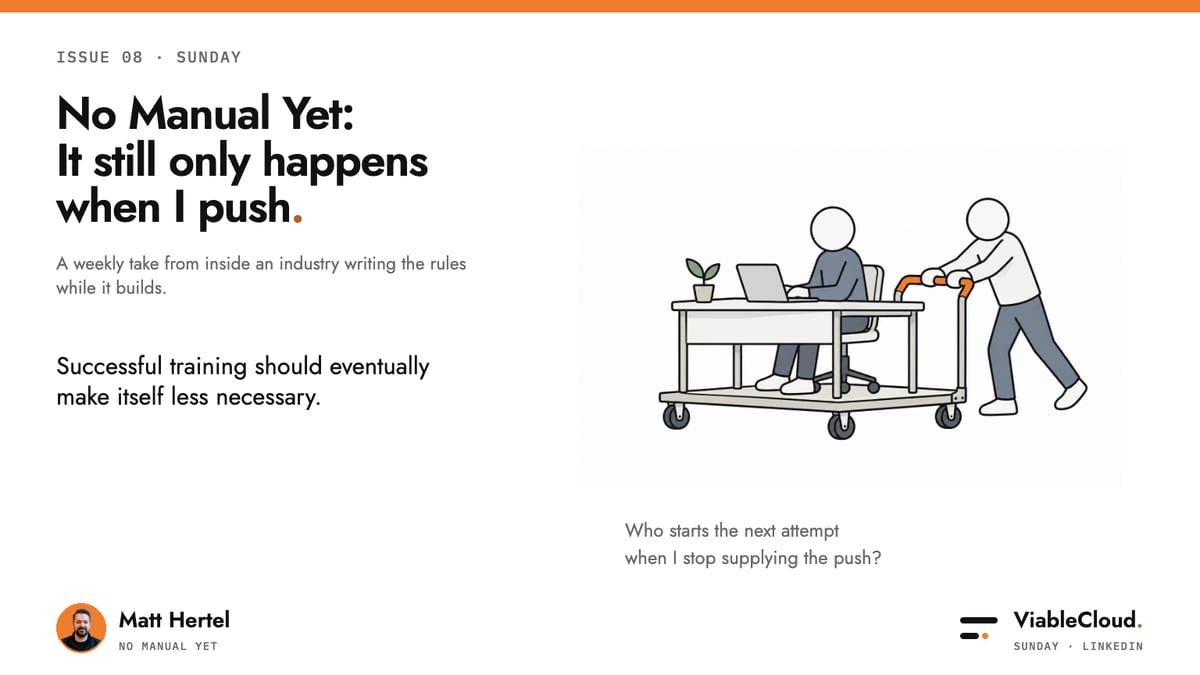
It still only happens when I push.
Pick a job to try this on: the Job Picker ranks your repeated jobs.
I spent another ungodly amount of time on LinkedIn looking at what people do after their first attempt with AI. A completely selfless act of research. Obviously.
- Andreas Welsch is having students build a system for a model company. I suggested an ugly new requirement to make them adapt it.
- Dharmesh Shah described AI surfacing a neglected domain negotiation, giving him a real opportunity he could still act on.
- Tadas Labudis described losing context when an AI-assisted document moved into review. I wanted the corrections kept with the work.
Each one gives you something useful for the next piece of work: a changed requirement, a reason to act or a correction worth keeping. But somebody still has to decide to continue and apply what they learned.
That was the main point of the first few AI Office Hours sessions I ran earlier in the year. My office hours, however, had a more basic problem: the next attempt still depended on me.
We had shown people how to turn a recurring job into a reusable skill. We had even made a bunch of skills for them.
They still were not creating their own. For quite a long time, every week I was asking myself: Who starts the next attempt when I stop supplying the push?
Let me tell you all about it, let’s go!
0 Proactivity + Praise = Disaster
I kept pushing. Every week, I came at it from a different angle with a different exercise. Nothing really worked beyond the initial enthusiasm during the sessions. Eventually, I pushed one colleague to create a skill with me. We made it and used it internally.
Success!
Then I publicly praised the colleague. A fair few more skills were added after that.
The one question still stands: why was it so hard getting people to create skills?
My read is that people did not see me as a peer. I was running the sessions and pushing them to make skills. They saw somebody in their own group create and use one instead of hearing the organiser ask for another one.
Apparently, the missing part of AI training was making one colleague look proactive.
Successful training should eventually make itself less necessary.
People can still ask for help. I just should not have to choose every job and push every attempt.
A training programme can finish when learning continues through normal work instead of waiting for the next organised session.
Practical help comes first
If your company has no AI office hours or a similar helping session, start one. It is the single biggest lever you can pull right now.
Make it about real work.
Bring a proposal, quote, client reply, onboarding task, report or support job. Work through it together and help people understand the result.
If you already run helping sessions, ask a colleague to lead the next attempt.
Choose the colleague others already turn to for a recurring proposal, report, reply or support job. Call them your AI Champion if you like.
Help them find the problem and build the first skill together. Then be their biggest champion. Use the skill where people can see it and give them the credit.
Now for the main event. Let's find a problem worth making into a skill.
Something you can implement by Friday
Start with a problem that has happened more than once, helps more than one person and ends in a result they can check.
Illustrative example. Imagine several colleagues produce the same client report each month. It needs the approved figures, the agreed sections and a clear flag on any conclusion that still needs a person.
Bring one real report and work through it together. As you work, write down what you keep doing: gather the approved figures, use the agreed sections, check every number and send unclear conclusions back to a person.
Turn that into a skill and try it on a fresh report. The structure is right, but the risks section is missing. Good. Save that check and run it again. Then record what passed, what still needs a person and the next improvement shown by the result. A clean rerun is a valid result too.
The skill has two tests: whether it works on fresh work and who starts the next use.
Do the same with one real job:
- Find the problem. Choose something that keeps coming back, matters to colleagues and produces a result they can inspect.
- Solve one instance together. Name the result you want. Keep the useful conversation, including the steps, decisions and checks that produced it.
- Turn it into a shared skill. Capture what starts the job, what goes in, what the skill does, how the result gets checked and what still comes back to a person.
- Test it on fresh work. If a second colleague can try it too, ask them to compare their fresh work with the result you agreed.
- Record what actually happened. Write down the expected result, what passed, what missed, what still needs a person and the next correction. A clean run does not need an invented miss.
- Publish and use it visibly. Share the skill internally, use it where people can see it and give the colleague credit. Share only what you have permission to share.
- Check who starts the next use. See whether somebody chooses it without a reminder. If nobody does, fix the obstacle and repeat with another colleague.
By Friday, aim for one attempted skill, one assessed result and one next improvement. One visible attempt is progress. It does not prove another push will never be needed.
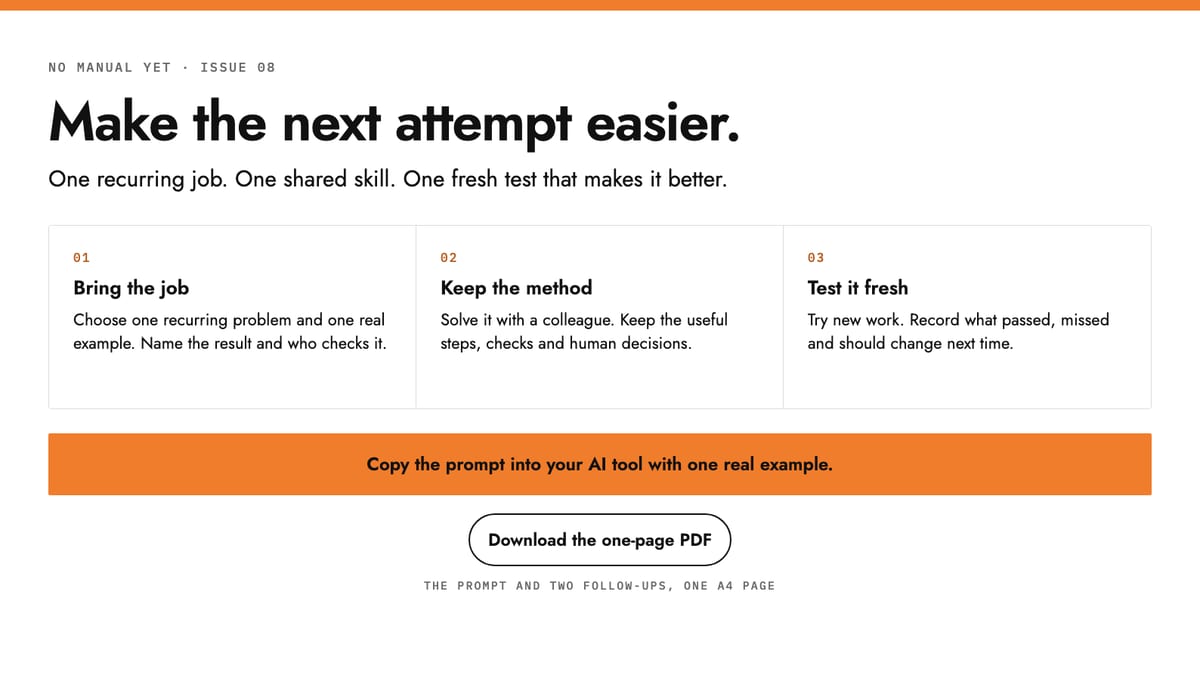
Download the one-page PDF · Get the skill ZIP
No manual yet
People learned how to make a skill. I’m still figuring out how the next attempt starts without my reminder.
I’m ridiculously excited about what people can build now, especially when the learning keeps moving between sessions.
I would just like them to occasionally build it before I remind them.
You survived another week in this strange new world AND another one of my articles. Amazing!
Over to you now: what has your team learned to do with AI that still only happens when you remind them?
I've made Make the next attempt easier. and Next Job Skill helper to use with this issue.
Take it with you
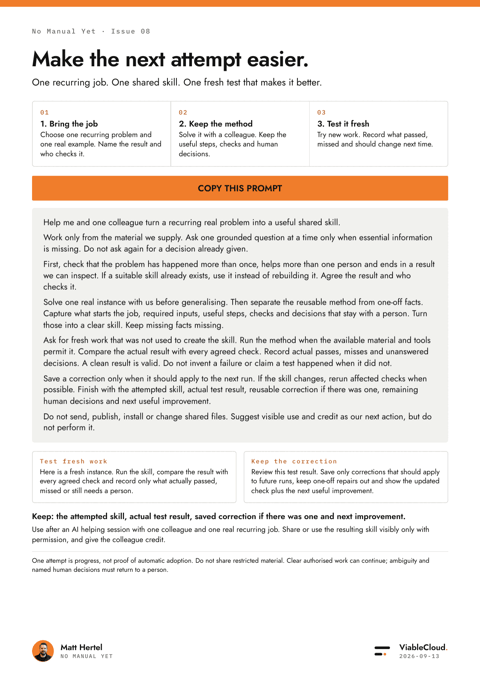
The helping session ended, but the next useful attempt still depends on somebody else supplying the push.
PDF · 43 KB
The helping session ended, but the next useful attempt still depends on somebody else supplying the push.
ZIP · 7 KB