Thursday complaint, Tuesday fix.
Pick a job to try this on: the Job Picker ranks your repeated jobs.
I spent another week on LinkedIn watching people measure AI.
A new model came out on Thursday. Benchmarks, launch videos, and the word AGI used so many times I thought it was a drinking game. I read all of it, obviously.
Very productive.
While everything was changing for the 700th time, the number that changed my week wasn't on those charts.
Last Thursday, I stumbled on a call recording where a very important customer told us that a feature was unusable. The following Tuesday, it wasn't.
Five working days. A bank holiday in the middle. One person, and about 300 agents.
Here's the thing. The new model was the least interesting part of my week. Exciting, sure, but the interesting part was observing how little is left between "the customer is unhappy" and "it's fixed".
So what is actually left between an unhappy customer and a fix? Excellent question, read on!
This week three things stood out
- We're still measuring the saved hours. The number that moved is the delta between a complaint and a fix.
- The bottleneck moved into the brief. Faster building means putting more effort into scoping tickets.
- The blocker that's left is a person. We might need more people after all.
Let's go!
Customer said "unusable"
Thursday, the weekly call with one of our customers. Half an hour in, they told us that a big feature was unusable. Things vanished from the dashboard. A report for next year's event came out with a different name on it. So they'd given up and were copying stuff by hand, which is slower and loses the history.
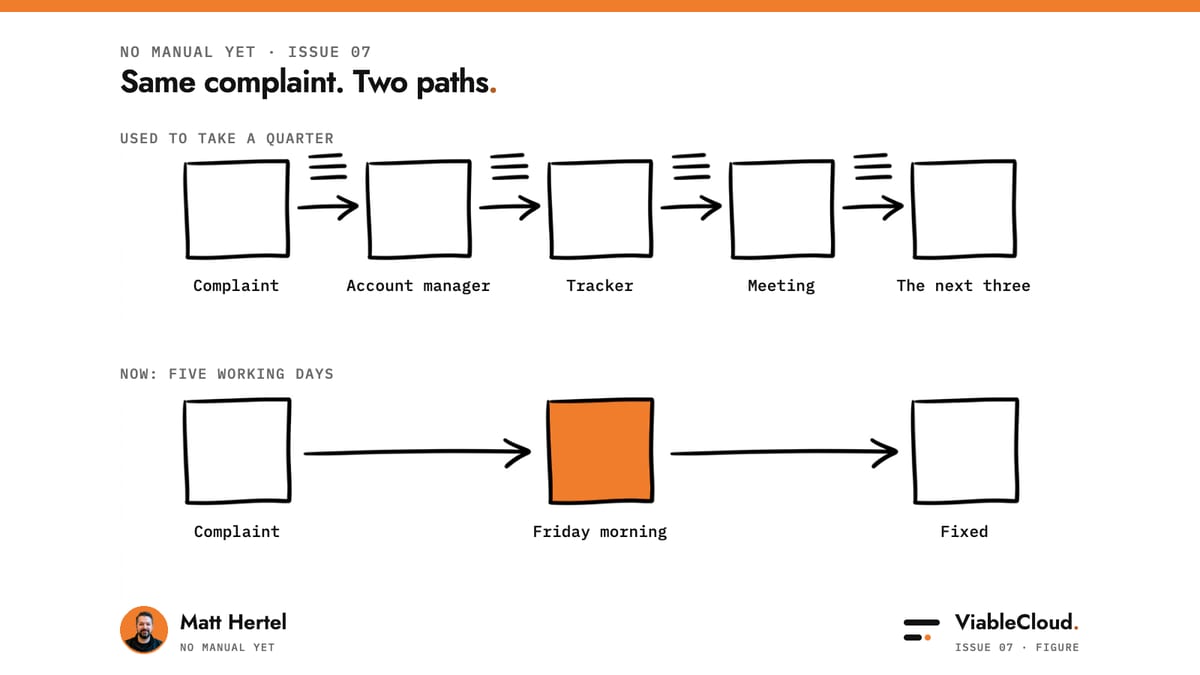
That feedback used to take a quarter to reach the code. Account manager, request tracker, prioritisation meeting, the next three. Everyone means well. The customer keeps copying stuff manually.
Agentic engineering to the rescue.
Friday, 9:35. I watched the recording back, gave AI the recording with a year of Slack history and about seventy old bug reports, and one clear directive:
"With all of this context, find all the reported issues and come up with a plan to address them. Don't stop at a shallow fix, find the root cause of the problems."
What came back was a one-page analysis. Every complaint on that call traced to five causes. Five causes behind seventy bug reports, several fixable in a day.
I posted the analysis in Slack and chatted for 10 mins with a PM.
By the end of Friday there were twenty tasks, nine finished fixes, and the first one was live and the customer informed. Tuesday, after the bank holiday, I closed twelve more and shipped 17 more fixes. Wednesday we did a big testing session. Result? The customer can stop copying stuff manually.
New world, new rules
The annoying thing is: nothing in it was hard.
The research was once insanely hard. A year of Slack, 70 bug reports and 3 digs through the code would have taken me a week on my own. That part is now a Friday morning.
The building was once impossible. 20 tasks used to be a fortnight, with a meeting to decide which ten we'd drop. Now the slow part is the requirement. People still decide what the feature needs to do. The system only helps once that's clear.
What was left, once those two collapsed, were the queues. Complaint to account manager. Account manager to tracker. Tracker to meeting. Meeting to the next three. Each one used to be justified by the cost of the work behind it (can't spend 2 weeks on something you're not 100% sure about).
When the work costs a morning, the queue is the cost.
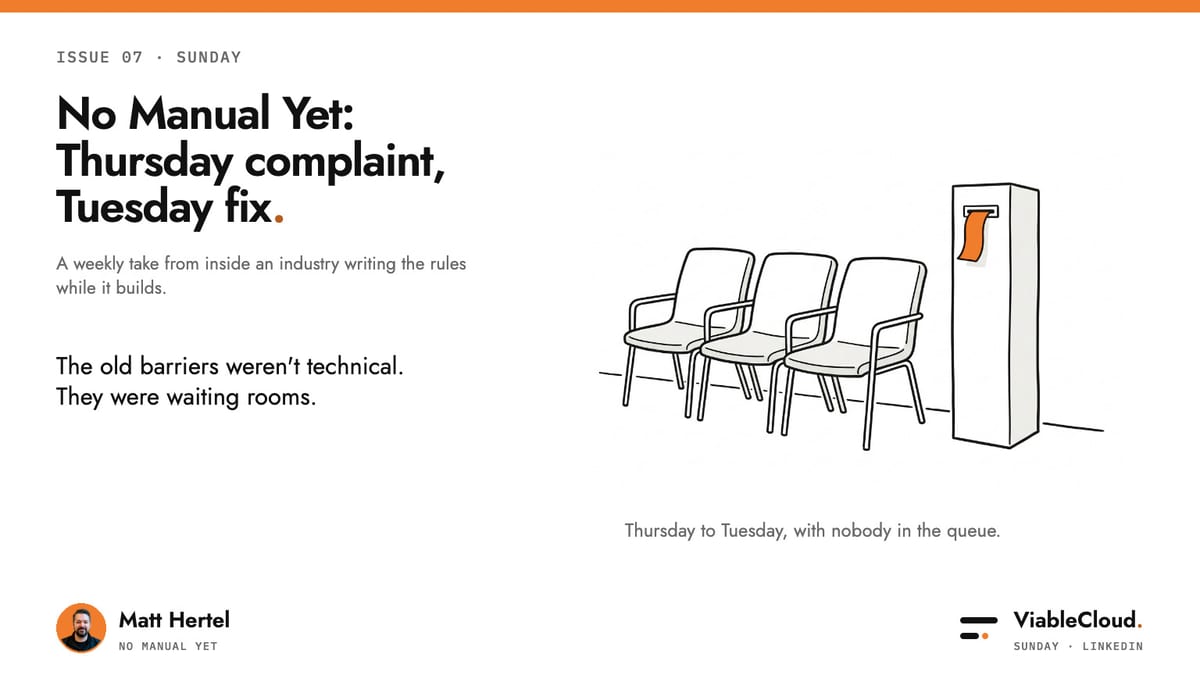
The old barriers weren't technical. They were waiting rooms.
Agents + Agency is the recipe for success
In a fully agentic world, agency will make you unstoppable.
We're still figuring out the rules (no manual yet mentioned!) of this new world, people with agency are shaping them.
I could've left "the old world" doing its thing:
- somebody would triage the call
- create a bunch of tickets
- get them to a team
- eventually work on them
Instead I discovered the call, spiked it, agreed the work, built it, shipped it and posted about it internally.
The gap between "I could fix that" and "I fixed it" has gone from a quarter to a morning. Most companies haven't noticed, so there's no queue for it yet. People with agency are about to have a very good few years.
The exact chain I use for the building half is in Wednesday's post: the context goes in, Claude or Codex builds, a reviewer checks it, it gets tested in the browser, and a Slack-ready announcement comes out the end.
Now you're asking yourself, will this issue be all about you boasting about how agentic you are?
Tempting, but no. This story was to showcase that we live in a completely new world. That we're not adapting fast enough and that we might need to reassess everything in our companies.
What better time to do that than when a new frontier model just came out?
What you can implement by Friday
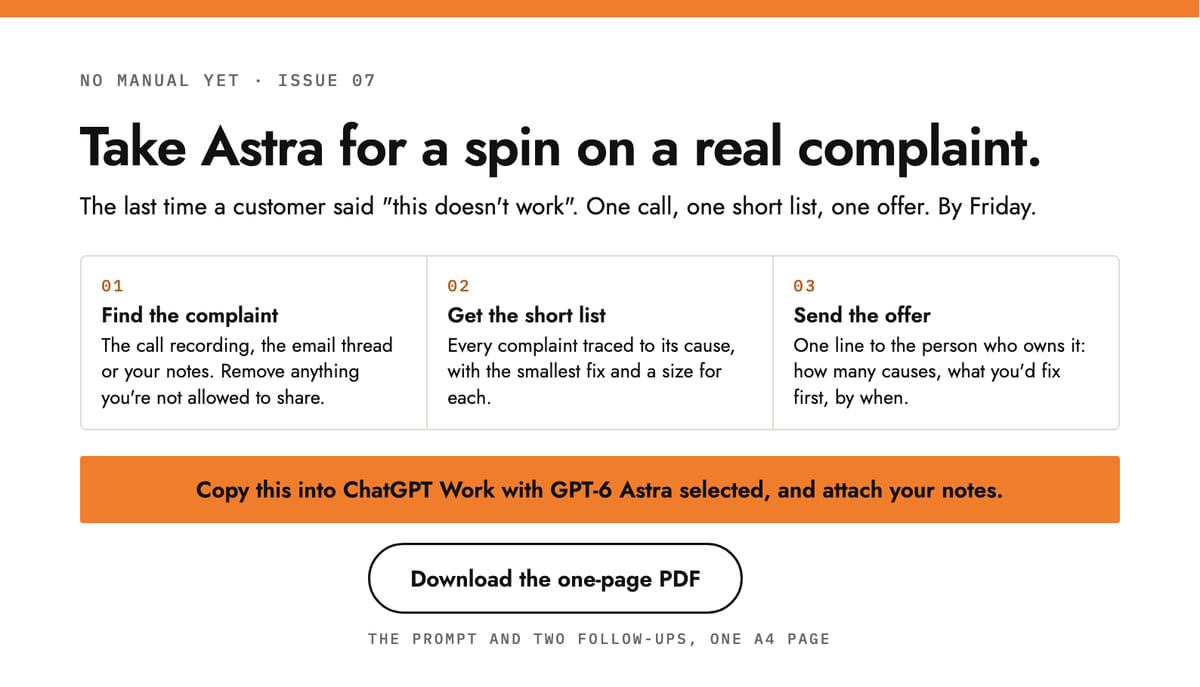
Take the new model for a spin on a real complaint.
GPT-6 Astra came out on Thursday. If you pay for ChatGPT Plus, Pro, Business or Enterprise, it's in your account now. On Plus it lives under Work rather than plain Chat. OpenAI's own examples are research into a document, filling forms and updating customer records. And it asks a question when the answer would change the outcome instead of guessing. That last one is why it suits this job.
Test it on the last time a customer said "this doesn't work". Find the recording, the email thread or your notes. Take out anything you're not allowed to share. Then give it this:
Here are the notes or transcript from a call where a customer told us something isn't working, plus anything else I've attached. Find every complaint, including the ones said in passing. Group them by cause, not by symptom: two complaints with the same root go together. For each cause write four lines: what the customer sees, why it costs us, the smallest fix that would make it go away, and a size in hours, days or weeks. Give me the shortest list that covers every complaint, ordered by what the customer feels most. Then write a one-line offer I could send to the person who owns this: how many causes, what I'd fix first, and by when. If anything in the notes is unclear, ask me before you guess.
Read the list as if the customer were reading over your shoulder. Send the one-line offer to whoever owns the fix. One call, one short list, one offer, by Friday.
I've made a one-page PDF with the prompt and two follow-ups: one that makes it interview you before anything gets built, and one that makes it list what it guessed.
If it worked, tell me. If it didn't, tell me too. I'd love to see the list.
No manual yet
The model was the least interesting thing that happened this week.
The research became a morning. The building became a day. What's left between an unhappy customer and a fix is people, and people move fast when somebody hands them a short list with a name on it.
I'm still ridiculously excited about what we can build now.
I'd just like one benchmark that measures how long a customer waits.
You survived another week in this strange new world AND another one of my articles. Amazing!
Over to you now: what did a customer complain about last week, and where is it right now?
Take it with you
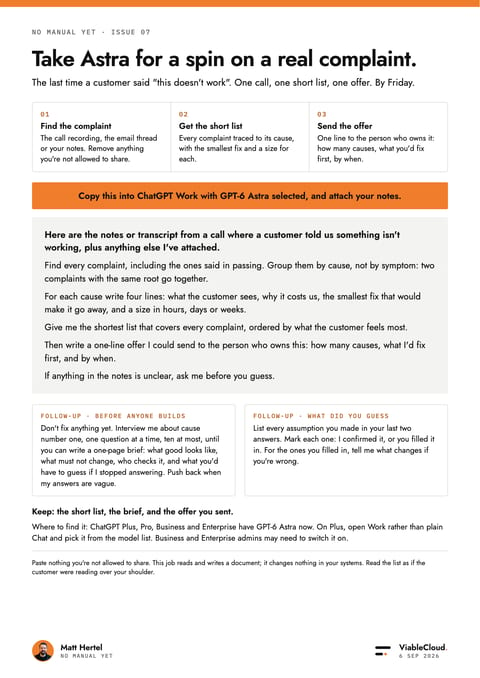
The one-page prompt from this issue: turn a customer complaint into a short list of causes, fixes and sizes plus a one-line offer, with two follow-ups.
PDF · 48 KB